Parks & Portland Lecture
A free, public lecture about telling Portland’s history through its public spaces. Add your email at the link below to reserve a seat.
More than a century ago, Dr. Magnus Hirschfeld, dubbed the “Einstein of Sex,” grew famous (and infamous) for his liberating theory of sexual relativity. Today, he’s been largely forgotten. Journalist Daniel Brook retraces Hirschfeld’s rollicking life and reinvigorates his legacy, recovering one of the great visionaries of the twentieth century. In an era when gay sex was a crime and gender roles rigid, Hirschfeld taught that each of us is their own unique mixture of masculinity and femininity. Through his public advocacy for gay rights and his private counseling of patients toward self-acceptance, he became the intellectual impresario of Berlin’s cabaret scene and helped turn his hometown into the world’s queer capital. But he also enraged the Nazis, who ransacked his Institute for Sexual Science and burned his books. Driven from his homeland, Hirschfeld traveled to America, Asia, and the Middle East to research sexuality on a global scale. Through his harrowing lived experience of antisemitic persecution and a pivotal late-in-life interracial romance, he came to see that race, like gender, was a human invention. Hirschfeld spent his final years in exile trying to warn the world of the genocidal dangers of racism. Rich in passion and intellect, The Einstein of Sex (W. W. Norton) at last brings together this unsung icon’s work on sexuality, gender, and race and recovers the visionary who first saw beyond the binaries. A century after his groundbreaking work — as the fights for personal freedom and societal acceptance rage on — Hirschfeld’s gift for thinking beyond the confines of his world has much to teach us. Brook will be joined in conversation by Catherine McNeur, author of Mischievous Creatures: The Forgotten Sisters Who Transformed Early American Science.
The Northwest Coast of North America is a treacherous place. Unforgiving coastlines, powerful currents, unpredictable weather, and features such as the notorious Columbia River bar have resulted in more than two thousand shipwrecks, earning the coastal areas of Oregon, Washington, and Vancouver Island the moniker "Graveyard of the Pacific." Beginning with a Spanish galleon that came ashore in northern Oregon in 1693 and continuing into the recent past, Coll Thrush's Wrecked (University of Washington Press) includes stories of many vessels that met their fate along the rugged coast and the meanings made of these events by both Indigenous and settler survivors and observers. Commemorated in museums, historical markers, folklore, place-names, and the remains of the ships themselves, the shipwrecks have created a rich archive. Whether in the form of a fur-trading schooner that was destroyed in 1811, a passenger liner lost in 1906, or an almost-empty tanker broken on the shore in 1999, shipwrecks on the Northwest Coast open up conversations about colonialism and Indigenous persistence. Thrush's retelling of shipwreck tales highlights the ways in which the three central myths of settler colonialism — the disappearance of Indigenous people, the control of an endlessly abundant nature, and the idea that the past would stay past — to be untrue. As a critical cultural history of this iconic element of the region, Wrecked demonstrates how the history of shipwrecks reveals the fraught and unfinished business of colonization on the Northwest Coast. Thrush will be joined in conversation by Catherine McNeur, author of Mischievous Creatures: The Forgotten Sisters Who Transformed Early American Science.
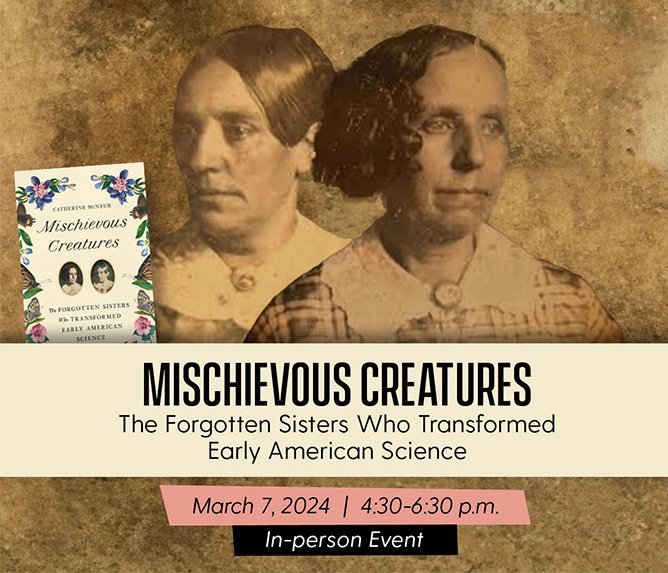
Mischievous Creatures is the untold story of Margaretta Hare Morris and Elizabeth Carrington Morris, two sisters from Philadelphia who sped the growth of American science in the nineteenth century. In addition to describing their lives, work, and why they should be remembered, Catherine McNeur will detail the many ways they were erased, how she stumbled upon them, and how their erasure speaks to issues of power in fields of science and history.
Catherine McNeur is a professor of history at Portland State University and the award-winning author of Taming Manhattan: Environmental Battles in the Antebellum City (2014) and Mischievous Creatures: The Forgotten Sisters Who Transformed Early American Science (2023).
Mischievous Creatures is the untold story of Margaretta Hare Morris and Elizabeth Carrington Morris, two sisters from Philadelphia who sped the growth of American science in the 19th century. In addition to describing their lives, work, and why they should be remembered, Catherine McNeur will detail the many ways they were erased, how she stumbled upon them, and how their erasure speaks to issues of power in fields of science and history.
Catherine McNeur is a professor of history at Portland State University and the award-winning author of Taming Manhattan: Environmental Battles in the Antebellum City and Mischievous Creatures: The Forgotten Sisters Who Transformed Early American Science.
All are welcome, but space is limited. Please RSVP via email to Helen Anne Curry if you plan to attend.
Join historian Catherine McNeur as she discusses her recent book, "Mischievous Creatures: The Forgotten Sisters Who Transformed Early American Science," with Manuscript Division historians Josh Levy and Elizabeth A. Novara.
McNeur uncovers the work of entomologist Margaretta Hare Morris and her sister botanist Elizabeth Carrington Morris, whose discoveries helped fuel the growth and professionalization of science in antebellum America – even as those same developments confined women in science to underpaid and underappreciated roles for generations to follow and helped erase the Morris sisters’ contributions.
Made at the Library is an event series highlighting works inspired by and emerging from research at the Library of Congress. Featuring authors, artists, and other creators in conversation with Library experts, this series takes a deep dive into the process of working with the Library’s collections.
A discussion of Mischievous Creatures at the Bend History Pub.
I’ll be discussing Mischievous Creatures in conversation with Andrew Robichaud, author of Animal City: The Domestication of America at the Massachusetts Historical Society. More information to come.
I’ll be joining graduate students in Boston University’s history department to talk about writing history.
I will be speaking with architecture students and faculty at EPFL in Lucerne, Switzerland about nineteenth-century urban livestock and what that meant for equity, health, and food safety in New York City.
I’ll be joining the Humanists of Greater Portland to discuss Mischievous Creatures and sign books. All welcome!
A discussion of Mischievous Creatures as part of a lecture series on “Environment, Climate, and Society” at Portland State University.
In her book Mischievous Creatures, historian Catherine McNeur uncovers the lives and work of Margaretta Hare Morris and Elizabeth Carrington Morris, sisters and scientists in early America. Margaretta, an entomologist, was famous among her peers and the public for her research on 17-year cicadas and other troublesome insects. Elizabeth, a botanist, was a prolific illustrator and a trusted supplier of specimens to the country’s leading experts. In conversation with Valerie Paley, McNeur reveals how New-York Historical’s library collections changed the course of her research and how these pioneering sisters contributed to the birth of American science.
Primary Source is a series of free and public programs exploring how the Patricia D. Klingenstein Library at the New-York Historical Society supports new research and historical inquiry. Join us for behind-the-scenes conversations about New York's past and present, deeply grounded in the Library's rich collections.
Registration required. The event takes place at 6pm Eastern, 3pm Pacific.
Join us for a conversation about turning your research and scholarship into public genre writing.
Our panelists are:
Daniel Pollack-Pelzner, visiting scholar of English and theatre. He writes about Shakespeare, musicals and contemporary culture; his articles have appeared recently in The New Yorker, The Atlantic, and The New York Times.
Catherine McNeur, associate professor of global, urban and American environmental history. She is the author of Mischievous Creatures: The Forgotten Sisters Who Transformed Early American Science (Basic Books, 2023), and has written articles for American Heritage and Scientific American.
John Perona, professor of environmental biochemistry and law. He is the author of From Knowledge to Power: The Comprehensive Handbook for Climate Science and Advocacy (Ooligan Press, 2021), and founder of Earthward, a weekly nonpartisan newsletter covering events in the climate and renewable energy space.
RSVP here
This event is part of PSU's annual Research Week, which honors and elevates the exceptional research, scholarship, and creative work of PSU faculty, staff, and students.
At an event sponsored by the University of Oregon’s History Department and Lane County Historical Society, I’ll be speaking about Mischievous Creatures: The Forgotten Sisters Who Transformed Early American Science, archival discoveries, and historical erasures. Plenty of food and drinks available while we talk!
Margaretta Hare Morris and Elizabeth Carrington Morris were two sisters from Philadelphia who sped the growth of American science in the 19th century, though its likely you’ve never heard of them.
In the recently published book Mischievous Creatures: The Forgotten Sisters Who Transformed Early American Science, environmental historian Catherine McNeur finally tells the history of the Morris sisters – their lives, work and how they should be remembered.
During this event, join McNeur to learn more about the Morris sisters and explore the many ways they were erased and how their erasure speaks to issues of power in fields of science and history. You will also learn how McNeur stumbled upon the Morris sisters, including the illustrations, correspondence and photographs of Margaretta and Elizabeth that she found in the Littell Family Papers within UD’s Special Collections.
McNeur is an associate professor at Portland State University and an award-winning author. Following the talk, she will be signing books. The UD Barnes and Noble Bookstore will be selling books before and after the event.
This event is co-sponsored by UD’s College of Arts and Sciences, the Department of Women and Gender Studies, the Delaware Environmental Institute (DENIN), the Department of History, and the Department of English.
Refreshments will be provided.
This in-person event is free and open to the public. It will not be recorded.
Registration is required as seating is limited.
In her new book, Mischievous Creatures, historian Catherine McNeur uncovers the lives and work of the forgotten Germantown scientists, Margaretta Hare Morris and Elizabeth Carrington Morris, who were at the center of scientific conversations and debates in the nineteenth century. Margaretta, an entomologist, was famous among her peers and the public for her research on 17-year cicadas and other troublesome insects. Elizabeth, a botanist, was a prolific illustrator and a trusted supplier of specimens to the country’s leading experts. At this talk, McNeur will discuss the research involved in recreating the Morris sisters’ lives, their community in Germantown, and the many ways that they’ve been erased from the history of science in the centuries since.
This talk is co-sponsored by the Wyck House, Stenton, Germantown Historical Society, and Germantown Friends School.
Registration required. Reception begins at 6pm. Free and open to the public.
The American Philosophical Society was the first venue where Margaretta Morris published her research on wheat flies in December 1840. I’ll be speaking about the Morris sisters and the research behind Mischievous Creatures at this free event. It will be broadcast virtually as well at 6pm Eastern, 3pm Pacific. Registration required.
At this book talk for Mischievous Creatures, I’ll be joined by Michelle Nijhuis, science writer and author of Beloved Beasts.
In this virtual book talk streaming over YouTube, I’ll be joining Christy Peterson of Vancouver, Washington’s Vintage Books to talk about the research and writing of Mischievous Creatures.
I’ll be joining Karl Jacoby, author of many amazing books, most recently The Strange Career of William Ellis, to talk about Mischievous Creatures at Book Culture.